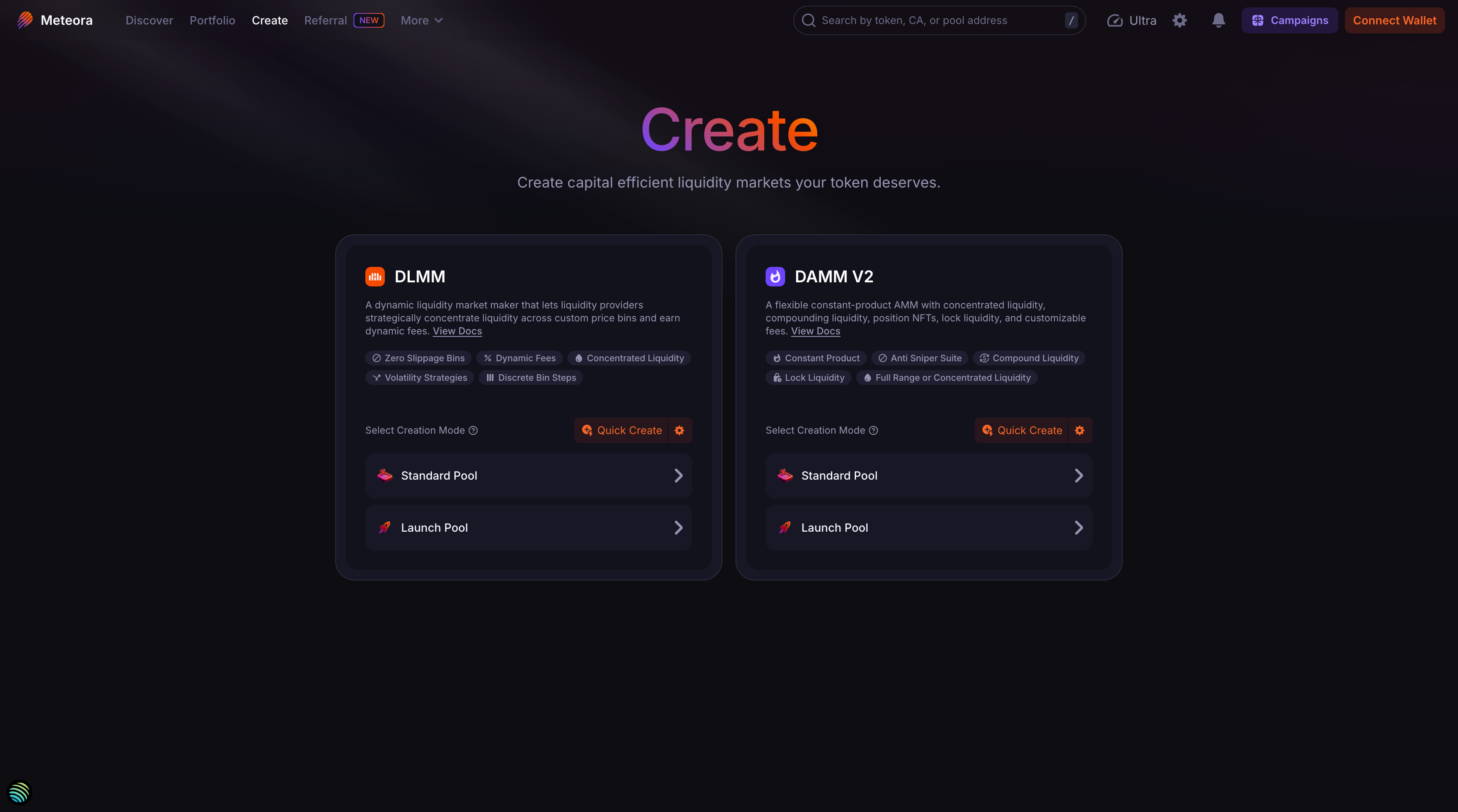
The Solana blockchain has developed into one of the most active ecosystems for decentralized finance, token launches, trading, and on-chain applications. As activity has expanded, the need for efficient liquidity infrastructure has become increasingly important. Meteora is one of the protocols addressing this need by providing a collection of liquidity and token-launch tools built specifically for Solana.
Rather than functioning only as a conventional decentralized exchange, Meteora describes itself as a Solana-native liquidity infrastructure protocol designed to help users and projects create, manage, and grow on-chain markets. Its technology includes Dynamic Liquidity Market Maker (DLMM) pools, Dynamic Automated Market Maker systems, Dynamic Bonding Curves, vaults, locks, and launch infrastructure.
This article explores what Meteora is, how its liquidity model works, why DLMM is important, how token projects use the platform, the role of liquidity providers, the MET token, benefits, risks, and Meteora's potential future within the Solana ecosystem.
Meteora is a decentralized liquidity protocol built on Solana. Its primary objective is to make liquidity more flexible and efficient for traders, liquidity providers, token creators, and launchpads.
Traditional automated market makers generally distribute liquidity according to predetermined mathematical formulas. Meteora takes a more configurable approach. Its infrastructure allows liquidity to be deployed according to different strategies, price ranges, fee structures, and launch configurations.
The protocol's product suite includes several major components, including DLMM, DAMM V1, DAMM V2, and Dynamic Bonding Curve technology. Together, these products form what Meteora calls its liquidity stack.
This broad product design allows Meteora to serve multiple purposes within Solana rather than focusing exclusively on token swaps.
Liquidity is fundamental to any active cryptocurrency market.
When a token has deep liquidity, traders can generally buy or sell larger amounts without causing substantial price movement. Low liquidity, on the other hand, can result in high price impact and greater volatility.
For new Solana projects, establishing a functional market can be particularly challenging. A token may have strong community interest but still experience poor trading conditions if sufficient liquidity is unavailable.
Meteora attempts to solve this problem by providing infrastructure through which projects can establish liquidity pools and customize how that liquidity behaves.
This makes the protocol useful not only to individual traders but also to developers, launchpads, market makers, and communities.
One of Meteora's most distinctive technologies is its Dynamic Liquidity Market Maker, commonly called DLMM.
DLMM uses a bin-based liquidity model. Instead of spreading liquidity continuously across an entire price curve, liquidity is organized into discrete price intervals known as bins.
Each bin represents a specific price point for a trading pair. Trades move through available liquidity across these bins as the market price changes.
Meteora's documentation explains that when a swap takes place entirely within a single active bin, the exchange rate in that bin is fixed, meaning the trade can have zero price impact within that bin.
This structure allows liquidity providers to decide where their capital should be concentrated.
Concentrated liquidity is designed to make capital more efficient.
Instead of providing liquidity across every possible price, a liquidity provider can place funds around a selected range. If trading occurs within that range, the capital can actively facilitate swaps and generate fees.
The advantage is that less capital may be required to support a particular trading range.
However, concentrated liquidity also introduces additional risks. If the market moves outside a liquidity provider's selected range, that position may become less active. Providers therefore need to understand the market and monitor their positions.
Meteora's DLMM model takes this concept further by allowing liquidity to be distributed across discrete bins and configured according to different strategies.
A liquidity pool contains assets that traders can exchange through a smart contract.
Liquidity providers contribute assets to these pools and can earn trading fees generated by activity.
Meteora's platform provides a range of pool configurations. Current pools display parameters such as fee rates, bin steps, total value locked, trading volume, fees generated, and active liquidity.
This level of information allows liquidity providers to evaluate markets before deciding where to deploy capital.
However, a pool showing high trading volume or attractive fees does not automatically mean it is a low-risk opportunity. Token volatility, liquidity movements, impermanent loss, and changes in trading activity can all affect results.
One of Meteora's most important developments is its focus on token launches.
The protocol provides infrastructure that allows projects and launchpads to create customized liquidity environments around newly launched tokens.
Meteora's official launch platform currently supports multiple launch approaches, including DLMM Launch Pools, DAMM V1, DAMM V2, and Dynamic Bonding Curves.
This gives projects greater control over how liquidity is introduced into the market.
For example, a project can configure factors such as liquidity distribution, price discovery, fee structures, and liquidity-locking arrangements depending on the selected launch mechanism.
Another important component of Meteora's ecosystem is the Dynamic Bonding Curve, or DBC.
Bonding curves are mechanisms that establish token prices according to predetermined mathematical relationships between supply and demand.
Meteora's DBC infrastructure is designed to provide customizable price discovery for new token launches. Its launch documentation describes options including flat, linear, and exponential curves, along with configurable parameters for liquidity and fees.
This can give token creators more flexibility than simply launching a token and immediately placing it into a conventional liquidity pool.
Meteora's ecosystem also includes Dynamic Automated Market Maker systems.
DAMM V1 provides liquidity infrastructure with features designed for price discovery and configurable fee mechanisms. DAMM V2 expands the design with a hybrid approach that combines elements of dynamic automated market making and concentrated liquidity.
According to Meteora's launch documentation, DAMM V2 supports both single-sided and full-range liquidity configurations and provides customizable fee systems.
These different pool types allow projects to select infrastructure based on their specific market requirements.
Liquidity providers are central to Meteora's ecosystem.
When users provide assets to a pool, their capital becomes available for traders. In exchange, liquidity providers may receive a portion of the trading fees generated by the pool.
The amount earned can depend on several factors, including trading volume, pool fee settings, liquidity concentration, market conditions, and the provider's position.
Meteora's DLMM architecture gives liquidity providers considerable control over how their capital is distributed.
This flexibility can be attractive to experienced DeFi users, but it also means that providing liquidity is more complicated than simply depositing tokens into a basic pool.
Meteora's ecosystem also includes the MET token.
According to Meteora's published crypto-asset documentation, MET serves as a utility and coordination asset within the protocol's ecosystem. The documentation describes potential roles related to participation, liquidity programs, token launches, and future staking-related mechanisms.
The token should not be viewed simply as a representation of ownership in a conventional company. Its role is connected to the protocol's decentralized ecosystem and incentive structure.
As with other crypto assets, MET can be volatile, and users should research its current tokenomics, distribution, vesting arrangements, and utility before making financial decisions.
Meteora's importance comes partly from its broad infrastructure approach.
A conventional decentralized exchange primarily focuses on swaps. Meteora extends its focus toward the underlying liquidity infrastructure that makes markets possible.
Its systems can support:
This creates an ecosystem in which token projects can potentially use Meteora throughout different stages of their market development.
Meteora provides several potential advantages for the Solana ecosystem.
DLMM gives liquidity providers more control over how capital is deployed.
Different AMM models allow projects and liquidity providers to select infrastructure suited to different objectives.
Meteora provides tools for projects launching new tokens and establishing initial liquidity.
The protocol is built specifically around Solana, allowing it to take advantage of the network's high transaction throughput and low-cost environment.
Projects can configure liquidity distribution, pricing mechanisms, fees, and launch conditions rather than relying on one standardized model.
Meteora works with launchpads and other projects across the Solana ecosystem, increasing its potential reach as liquidity infrastructure.
Despite its advanced technology, Meteora is not risk-free.
The first major risk is impermanent loss. Liquidity providers can experience losses relative to simply holding their assets when token prices move significantly.
Concentrated liquidity introduces another challenge. A position can become inactive if the market moves outside its selected range.
Smart-contract risk is also important. Like any DeFi protocol, Meteora relies on blockchain programs, and vulnerabilities can potentially result in financial losses.
New token launches present additional risks. Newly created assets can be highly volatile, and some tokens may have limited liquidity or concentrated ownership.
Users should also be cautious about phishing websites, fake tokens, malicious contracts, and fraudulent links.
High fee yields or attractive liquidity statistics should never be interpreted as guaranteed returns.
Meteora's future is closely connected to the continued development of Solana's DeFi and token-launch ecosystem.
The protocol has already expanded beyond basic liquidity pools into a broader infrastructure stack for launches, market creation, and liquidity management. Its official launch platform continues to emphasize customizable liquidity configurations and tools for launchpad partners.
As Solana attracts more developers, traders, stablecoins, memecoins, decentralized applications, and financial protocols, the demand for sophisticated liquidity infrastructure could continue to grow.
The challenge for Meteora will be maintaining security, improving usability, managing liquidity efficiently, and continuing to provide useful infrastructure as the market evolves.
Meteora has developed into an important piece of Solana's decentralized finance infrastructure. Rather than operating solely as another token-swapping platform, it focuses on the deeper problem of how liquidity is created, distributed, managed, and maintained.
Its DLMM technology provides a distinctive approach to concentrated liquidity through discrete price bins. Meanwhile, DAMM systems, Dynamic Bonding Curves, launch pools, liquidity locks, and other tools give projects and liquidity providers multiple ways to build and manage markets.
For traders, Meteora can provide access to a wide range of Solana-based markets. For liquidity providers, it offers sophisticated strategies for deploying capital. For token creators and launchpads, it provides infrastructure for establishing markets and managing liquidity from launch onward.
However, the flexibility of Meteora also means users need to understand the risks. Impermanent loss, market volatility, smart-contract vulnerabilities, liquidity changes, and newly launched token risks can all affect outcomes.
Overall, Meteora represents an important evolution in Solana DeFi: a move from simple decentralized swapping toward programmable and customizable liquidity infrastructure. As Solana's on-chain economy continues to develop, Meteora's ability to support the creation and growth of liquid markets could make it an increasingly significant part of the ecosystem.